
FOREIGN AFFAIRS SENIOR OFFICIAL: SWAZI BRIDGE FRAMING OF ESWATINI—TAIWAN RELATIONS LACKS NUANCE AND BALANCE
Thanks for the piece regarding President Lai's visit, it really captures the moment and the sensitivities around it. Ngiyabonga kakhulu for the balanced effort. I just thought I could share a bit of context from our side that might help round out the framing. All off the record and not for further dissemination.
The idea that Eswatini is walking a tightrope is understandable, but honestly, akusiyo lelo indlela lesiyibuka ngayo lendzaba. From where we sit, it is less about being caught between powers and more about being consistent. The relationship with Taiwan is not something new or reactive. Sesibe nayo iminyaka leminyenti, and it has grown into something quite practical and grounded in real cooperation.
When you look at sectors like health, agriculture, education, and rural electrification, the partnership has been very direct and responsive to our needs. In very practical terms, when you aggregate infrastructure support, technical assistance, scholarships, health programmes, and budget aligned cooperation over time, you are looking at support that runs into hundreds of millions of US dollars cumulatively, conservatively estimated in the range of USD 200 million to USD 400 million over the years.
Loko akusilo liciniso lelingadvonselwa phansi, it is real value that has touched communities directly. So when the narrative leans toward minimizing this relationship, almost reducing it to something symbolic or marginal, it does not quite reflect the lived reality. Kukhona umsebenti lowentiwe, futsi minyenti and uyabonakala. So the decision to maintain that relationship is less about pressure and more about credibility.
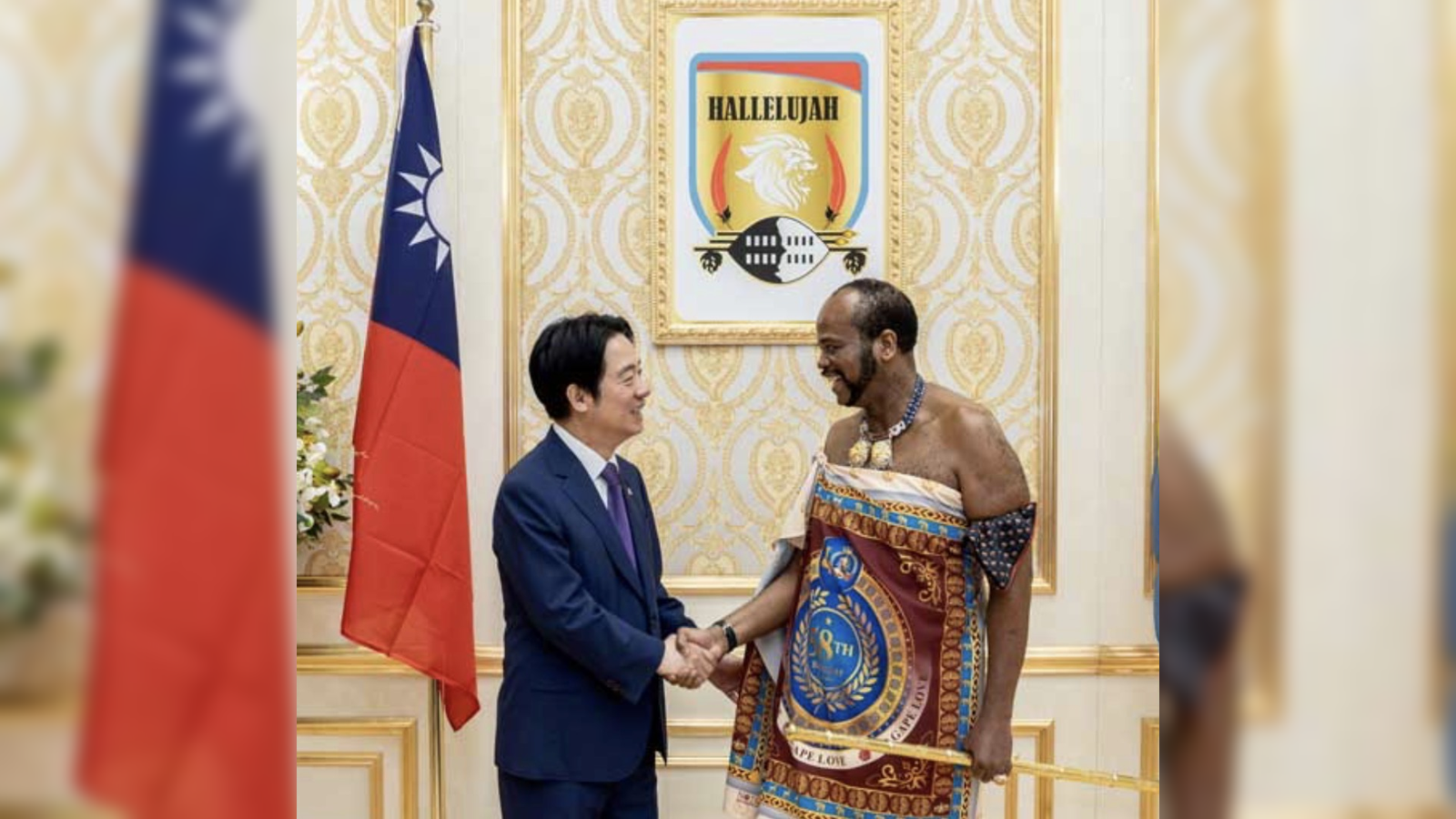
 King Mswati posing with Taiwan President Lai Ching-te
For a country like ours, keeping your word and being consistent in your partnerships matters a great deal. It builds trust over time. On the economic side, the tariff point is valid and important, but sometimes it can dominate the narrative in a way that misses the bigger picture. Not all partnerships are measured the same way. What we have with Taiwan is quite targeted and aligned with where we want to go as a country.
Loko nako kunesisindvo sayo even if it does not always show up in headline trade numbers. At the same time, it would be useful, in the interest of balance, to also look at comparative examples. For instance, which countries of a similar size and economic structure to Eswatini have demonstrably transformed their economies purely on the basis of Chinese tariff preferences or diplomatic alignment?
Kungasita kakhulu kubona leto tibonelo ngendlela that allows for fair comparison especially for a country like ours that does not really penetrate the Chinese market in a significant way. Equally, there are cases where countries have switched recognition away from Taiwan toward Beijing and the anticipated benefits have been more complex or slower to materialise than expected.
Examples often cited in broader discourse include countries such as Zambia or Sri Lanka where large scale financing has come with longer term fiscal and structural considerations that require careful management. Akusho kutsi akukho lokuhle lokwentiwe, but it does show that the picture is not always straightforward. On the issue of overflight challenges and pressure, if anything, it highlights why smaller states need to guard their space.
Akusiko kutsi sifuna kungqundzana, but it is about making sure that decisions remain ours. Kumele sitikhetsele. The One China framing also tends to be presented as if it is uniform everywhere, but in practice countries interpret and apply it differently. Eswatini’s position is simply one expression of that sovereign space. Then on the visit itself, even with the early complications, the fact that President Lai Ching-te did arrive, engagements took place, and agreements were signed, that actually speaks more to resilience than disruption.
Kubonisa kutsi lobuhlobo buyasebenta nalapho kunetingcinamba. Above all, ngicabanga kutsi kubalulekile kutsi lendzaba be reported in a balanced manner, factual, futsi lehlola tonke tinhlangotsi. These are complex issues, and the framing matters. A more objective and fact based assessment helps ensure that Eswatini is not simply portrayed as reacting to pressure, but as a country making considered and informed choices.
Ngalamafisha, maybe the story is not so much about a country under pressure, but about a country that has made a choice and is standing by it in a consistent and measured way. Yours with the utmost respect...
NB: The senior official asked to use a pen name.